
How Much Does Mobile App Development Cost in 2026, and When Does It Actually Make Sense
Mobile app development is often seen as “the next big step” for a business.
Many companies reach a point where they start asking themselves:
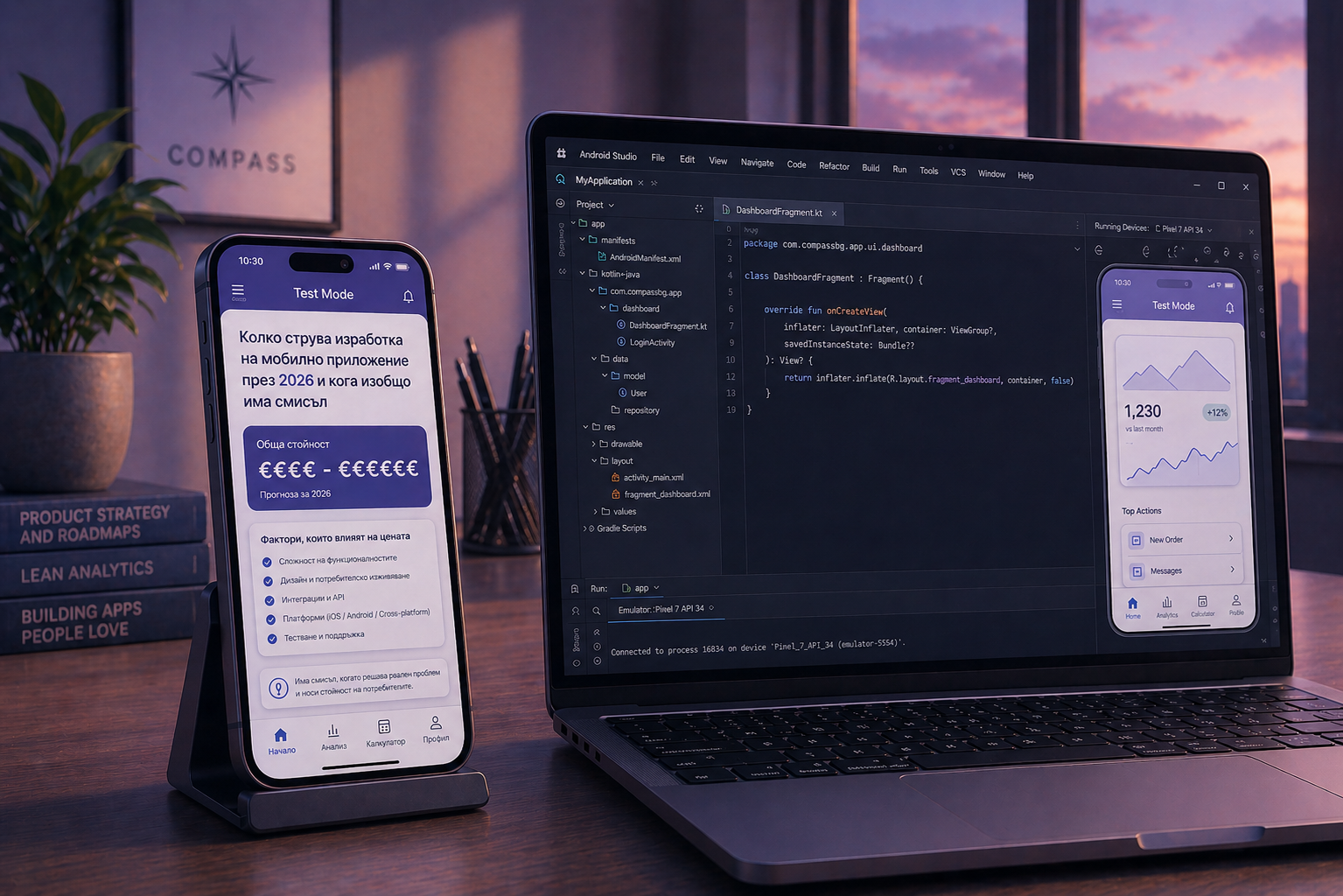
"Do we need a mobile app?"
At first glance, the answer seems easy. Everyone uses a phone. People spend a huge share of their time in mobile apps. Push notifications are a direct channel to the customer. The user experience can be faster, more convenient, and more personalized.
But the truth is that a mobile app isn't always the right first step.
In some cases, it can be a powerful tool for growth, customer retention, and increasing repeat sales. In other cases, it can turn into an expensive investment that delivers no real return.
That's why the question isn't just:
"How much does it cost to build a mobile app?"
The more important question is:
"Does it make sense for your business right now?"
"But the truth is that a mobile app isn't always the right first step."
What an app project includes
A mobile app isn't just a nice-looking screen the user installs on their phone.
Behind a real, working app there's a complete digital system. It includes strategy, user journey, design, logic, a database, a backend, integrations, testing, and publishing on the App Store and Google Play.
An app project typically goes through several key stages.
UX and user flow
The first is UX and user flow. This is the phase where you define how the user will use the app. How they'll sign up, how they'll navigate, how they'll place an order, make a booking, submit a request, or perform any other action. This isn't about visuals — it's about logic and ease of use.
UI design
Next comes UI design — the visual side of the app. This includes screens, buttons, cards, forms, profiles, menus, colors, typography, and the overall feel of the interface.
Backend development
Then comes backend development. This is the system "behind the app" that handles the data, users, orders, bookings, subscriptions, notifications, and all the processes that aren't directly visible on the screen.
Database
On top of that, there's a database where the information is stored — users, products, content, orders, statuses, payments, settings, and more.
API integrations
Many apps also require API integrations. This can be a connection to an online store, a CRM, an ERP, a payment system, a courier service, an external platform, Google Maps, a booking system, or other software.
Testing and publishing
Finally come the testing and publishing stages. The app has to be tested on different devices, screen sizes, and operating systems. After that, it's prepared for publishing on the App Store and Google Play — which has its own technical requirements.
The main factors that determine the price
The cost of building a mobile app in 2026 depends on a few key factors.
1. Platforms: iOS, Android, or both
The first important factor is which platforms the app will be built for.
If the app only needs to work on iOS, the project's scope is more limited. The same goes for Android only. But in most real-world business cases, the app needs to be available on both platforms.
That means more work, more testing, and more responsibility during maintenance.
With iOS, you need to align with Apple's requirements, the App Store profile, publishing rules, and device specifics. With Android, there's a much wider variety of devices, screen resolutions, and OS versions, which makes testing broader.
That's why a single-platform app is usually more affordable, while an app for both iOS and Android requires a more substantial budget.
2. Technology: native or cross-platform
The second factor is the technology.
An app project can be built as a native application or as a cross-platform application.
Native development
Native development means the app is built separately for iOS and Android, using the technologies specific to each platform.
Performance and stability
This often delivers excellent performance, stability, and access to all the device's capabilities — but it's usually more expensive and slower to develop.
The cross-platform approach
The cross-platform approach lets you build an app for both iOS and Android from a single shared codebase.
Time and budget
This can reduce both time and budget, especially for business apps, online stores, booking platforms, training apps, content apps, or customer portals.
The choice shouldn't be made on price alone. It needs to take into account the project's goals, the required functionality, future development, and expected load.
3. Functionality and business logic
The biggest factor in the price is the functionality.
Building an app with a few information screens, a contact form, and a basic profile is one thing.
Building an app with sign-up, customer profiles, subscriptions, online payments, chat, push notifications, bookings, a map, real-time tracking, a complex database, user roles, and an admin panel is something else entirely.
The more logic an app contains, the higher the price.
For example, if the app only needs to display content, the budget will be lower. If it needs to manage orders, payments, inventory, user actions, and external integrations — the project becomes significantly more complex.
Especially demanding features include:
- registration and login;
- user profiles;
- online payments;
- subscriptions;
- push notifications;
- chat or messaging;
- bookings;
- maps and locations;
- online store integration;
- an admin panel;
- different user roles;
- real-time content.
Each one of these adds time for planning, design, development, and testing.
Price ranges for mobile app development in 2026
The most realistic way to talk about price is in ranges, because every app has a different scope.
Basic mobile app: €3,000 – €8,000
This range covers simpler apps with a limited number of screens and lighter functionality.
Mid-tier app: €8,000 – €25,000
This is the most common range for real business apps.
Complex mobile app: €25,000+
This range covers larger-scale apps with complex architecture.
Basic mobile app: €3,000 – €8,000
This range covers simpler apps with a limited number of screens and lighter functionality.
This could be a business-presentation app, a catalog, a content app, a basic customer area, an inquiry form, news, events, or a simple internal tool.
There's usually no complex logic, heavy integrations, or multiple user roles at this level.
This kind of app can be a good fit if you want a first version to test an idea, or to give more convenient mobile access to an existing service.
Mid-tier app: €8,000 – €25,000
This is the most common range for real business apps.
At this level we're talking about an app with user profiles, a database, an admin panel, push notifications, integrations, orders, bookings, content, or specific business logic.
For example, an app for an online store, a services platform, a fitness program, training, bookings, a membership area, or a customer system will likely fall in this range.
At this point more serious planning is required, because the app isn't just a visual product — it's a working system.
Complex mobile app: €25,000+
This range covers larger-scale apps with complex architecture.
These could be marketplace platforms, social networks, apps with real-time chat, geolocation, AI features, multiple user types, personalized content, complex integrations, subscription models, or heavy load.
On projects like these, the price can go well above €25,000, because the development involves not just an app, but an entire digital ecosystem.
At this level, you have to think not just about the first version, but also about scalability, security, maintenance, data analysis, and future growth.
When it makes sense to invest in a mobile app
A mobile app makes sense when you already have a foundation in place.
The first clear signal is that you have active customers.
If people are already buying, booking, using your services, or interacting with your business, an app can make that process easier.
The second signal is that you have repeat sales or repeat actions.
If customers come back often, a mobile app can increase both convenience and purchase frequency. This applies to online stores, subscription services, fitness programs, beauty studios, training, deliveries, bookings, and other business models.
The third signal is that you want to build stronger engagement.
An app gives you push notifications, personalized content, loyalty programs, new-product alerts, reminders, and direct communication with the customer.
A mobile app is powerful when it doesn't just attract the user — it brings them back.
It's especially useful when you already have an audience and want to keep them.
When it doesn't make sense to start with an app
A mobile app isn't a magic fix for a lack of sales.
If your business has no traffic, no clear offer, no established online channels, and no real demand from users, an app won't solve those problems.
One of the most common mistakes is launching an app before having a working website, an online store, an advertising strategy, or clear communication.
If people aren't finding you on Google yet, if your ads aren't working, if your site isn't converting, if you don't have content or trust built up — a mobile app can turn into an expensive step at the wrong moment.
An app makes sense when there's already something to build on top of.
It doesn't make sense if:
- you don't have a steady flow of customers;
- you don't have sales;
- you don't have a clear strategy;
- you don't have a reason for the user to open the app regularly;
- you don't have a budget for maintenance and growth;
- you expect the app on its own to create demand.
An app isn't a replacement for a marketing strategy. It's a tool within one.
The most common mistake
The most common mistake is starting with a mobile app instead of with a working online channel.
Many businesses want an app because it sounds modern. But modern isn't always effective.
If the customer doesn't know you exist, it doesn't matter whether you have an app. If you have no traffic, there's no one to download it. If you have no clear reason for people to use it regularly, it'll get uninstalled quickly — or never downloaded at all.
First, there has to be a working foundation:
- a website or online store;
- a clear offer;
- traffic;
- trust;
- sales;
- a customer retention strategy.
Once that's in place, a mobile app can build on top of it.
An online store or website attracts new users. A mobile app retains the existing ones.
That's the big difference.
"An app is a tool for growth, not for starting out."
An app is a tool for growth, not for starting out
A mobile app can be an exceptionally strong asset for a business.
It can improve the customer experience, drive repeat sales, create a direct communication channel, and build a stronger connection between the brand and the user.
But only when there's a clear reason for it to exist.
In 2026, building a mobile app can cost anywhere from €3,000 for a more basic project to €25,000+ for a more complex platform. The real price depends on the platforms, the technology, the functionality, the integrations, the design, and the business logic.
But the most important thing isn't just how much it costs.
The most important thing is whether the app will work as part of a broader business strategy.
If your business already has customers, sales, and a need for stronger engagement, a mobile app can be the right next step.
But if your online presence isn't working yet, an app won't fix it.
It's not a starting point.
It's a tool for growth.
An app isn't always the first step
The truth is that a mobile app isn't always the right first step.
The price depends on the scope
The real price depends on the platforms, the technology, the functionality, the integrations, the design, and the business logic.
A tool for growth
It's not a starting point. It's a tool for growth.
Do you need a mobile app in 2026?
If your business already has customers, sales, and a need for stronger engagement, a mobile app can be the right next step. But if your online presence isn't working yet, an app won't fix it. It's not a starting point. It's a tool for growth.
Get in touch